Three layers of sports match information
Producers often hear vendors describe a “complete live feed,” yet sports data arrives in three distinct tiers that support very different commentary tasks. Treating a basic scoreboard update as if it carried tactical depth is the fastest way to produce hollow or inaccurate copy.
The first tier is basic competition scoring: kick-off, period breaks, goals or points, disciplinary cards, and substitutions. In lower leagues and amateur tournaments, this layer is commonly recorded by a volunteer scorer on a tablet or entered into a league portal. It is sufficient to build a factual chronology, but it cannot tell an AI model whether a goal came from a counter-attack or a set piece unless a human adds that qualifier.
The second tier is on-ball event data, pioneered at scale by suppliers such as Stats Perform (Opta), Sportradar, and Genius Sports. Trained human analysts log every pass, tackle, shot location, and body part in structured schemas often mapped to IPTC SportsML or NewsML-G2. This tier powers reliable pre-match notes and live statistical milestones across competitions such as the Premier League, LaLiga, and the Bundesliga.
The third tier is optical and skeletal tracking, delivered by systems like Hawk-Eye Innovations and Second Spectrum. Multi-camera arrays capture twenty-five to fifty coordinate frames per second for all players and the ball. Platforms such as AWS Bundesliga Match Facts or NFL Next Gen Stats use this layer to compute sprint speed, passing lanes, and expected threat. For commentary desks, optical data supplies rare spatial context, though it requires careful translation so on-air callers do not drown listeners in decimal numbers.
What a feed never sees on its own
Even the richest optical feed has blind spots that matter deeply to a sports audience. A coordinate file does not know that a gusting crosswind is ruining every corner kick toward the north stand, that a goalkeeper pulled up gingerly during the warm-up, or that a veteran captain is making her final home appearance before retirement.
Similarly, event streams struggle with ambiguous moments until an official ruling lands. Under IFAB Laws of the Game, a shot that strikes a defender and changes direction may initially be coded as a shot on target by the attacker, only to be reclassified as an own goal ten minutes later. An AI tool that generates an instant social post from the first packet will repeat the wrong scorer unless your pipeline listens for revision packets and holds publication during contested reviews.
Annotated Feed Packet Example (SportsML Style)
event_id=4419 | clock="63:18" | type="shot_goal" | player_id="P-09" | assist_id="P-07" | qualifier="fast_break,left_foot" | status="provisional"
Editorial note: Notice the status="provisional" flag. Commentary tools should surface provisional events to the booth as unconfirmed notes, never as final published text.
Building a clean input pack for grassroots and club desks
Most volunteer broadcasters and semi-professional clubs do not hold commercial licences to Opta or Hawk-Eye. Fortunately, small teams can achieve high editorial accuracy by standardising a lightweight pre-match and live input sheet before any language tool touches the text.
- Verified squad roster: One canonical table containing shirt number, full spelling, preferred broadcast name, position, and phonetic pronunciation guide. Never let a tool guess diacritics or hyphens.
- Fixed event vocabulary: Agree on twelve to fifteen short tags for live logging—such as goal-open-play, goal-set-piece, yellow-dissent, injury-stoppage, and tactical-switch.
- Synchronised clock reference: Start a single stopwatch aligned with the referee’s whistle and record stoppage time explicitly as
45+2rather than47, matching FIFA and UEFA reporting conventions. - Separate facts from impressions: Keep objective match events in one column and the commentator’s eye-witness observations in a second column. Tell your summary tool which column is verified fact and which is qualitative colour.
Managing feed latency in the booth
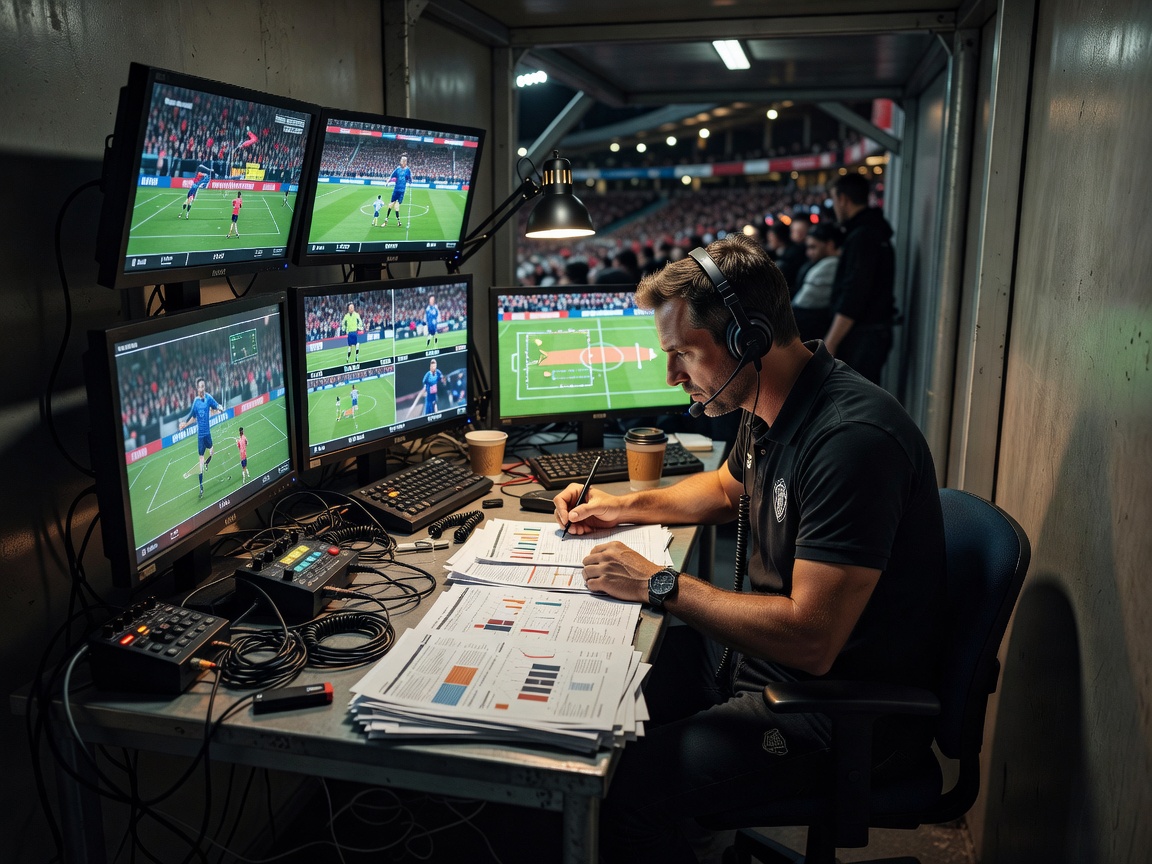
Broadcast television signals delivered over satellite or streaming encoders frequently trail stadium action by six to forty-five seconds, while dedicated low-latency SRT or venue feeds sit much closer to real time. If your commentary prompt screen pulls from a faster stadium API than the remote monitor your caller is watching, the tool will spoil a goal before the commentator sees the shot leave the striker’s boot.
Producers working on remote commentary setups should intentionally buffer statistical alerts to match video delay, keeping the booth synchronised with the pictures the audience actually receives.
Comparing common match input sources
| Input Source | Typical Latency | Editorial Strength | Primary Risk |
|---|---|---|---|
| Commercial Event API (Opta / Sportradar) | 1–5 seconds | Rich historical benchmarks and consistent player IDs. | Provisional scorer or VAR reversals require correction hooks. |
| Optical Tracking (Hawk-Eye / Second Spectrum) | 2–10 seconds | Verified speeds, spacing, and off-ball positioning metrics. | Technical jargon that obscures the narrative if not translated. |
| Club Manual Live Sheet | 5–30 seconds | Captures weather, crowd mood, and local storylines. | Typographical errors under time pressure during frantic phases. |
| Live Audio Transcript (Whisper / Studio ASR) | 2–8 seconds | Preserves exact commentator phrasing for clip indexing. | Misspelled player names and crowd-noise hallucinations. |
When your desk treats input hygiene as an editorial craft rather than an IT chore, every downstream tool becomes calmer and more trustworthy. From here, the next question is how to place those structured facts in front of a live commentator without breaking their rhythm.